
Systems Leadership in Action: Team Development at the Villars Institute
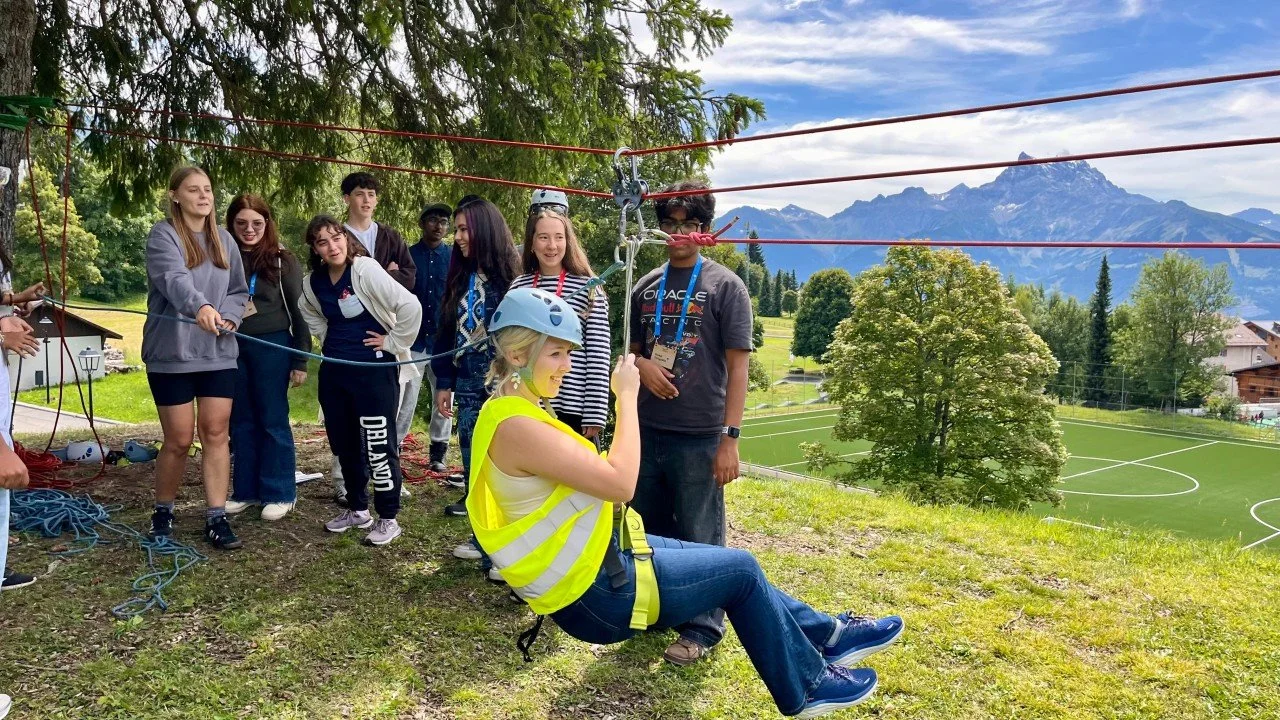
Photo courtesy of Villars Institute
Last month, ECAT had the privilege of designing and facilitating a unique team-building experience for the Villars Institute’s Ecopreneurship Program (VIP-e 2025). Building on the Villars Institute's innovative approach to systems leadership, we created an experiential learning activity that would bring systems leadership principles to life through adventure-based problem-solving.
Designing for Systems Thinking
The participants were given a mountain rescue simulation that required them to organize and navigate team dynamics while managing unexpected challenges. The activity divided 24 young ecopreneurs into four interconnected teams: Rescue Operations Management, Supply, Crevasse Rescue, and Bridge Operations. Each team's decisions and actions created ripple effects throughout the entire system, much like the real-world challenges these future leaders will face in building sustainable ventures.
The Challenge Unfolds
Each team had distinct responsibilities that required precise coordination and collaboration. The Rescue Operations Management team (ROM) acted as the central command, coordinating all communications and resource allocation. The Supply team managed crucial rescue equipment, preparing specific gear kits on demand. Crevasse Rescue teams, working in groups of three, used technical rope systems to evacuate victims from a simulated ice crevasse. Meanwhile, the Bridge Operations team constructed a rope bridge system for transporting rescued victims across a challenging river crossing.
The scenario became increasingly complex as teams discovered additional victims and faced unexpected complications, such as equipment limitations and injured rescuers. Each team received detailed instruction cards and technical guides, allowing them to learn and execute their roles while maintaining clear communication channels through ROM. This created a dynamic environment where success depended entirely on effective system-wide coordination.
As unexpected challenges emerged such as additional victims, equipment limitations, and injured rescuers, teams had to adapt quickly while maintaining clear communication through ROM. This created ideal conditions for testing real-world systems leadership.
Leadership in Action
The simulation revealed how systems leadership traits naturally emerge under pressure:
Teams quickly learned that no single group could succeed in isolation
Communication patterns evolved as participants recognized the need for coordinated action
Leaders emerged who could balance immediate needs with system-wide impacts
Groups demonstrated remarkable adaptability when faced with unexpected challenges
Beyond Traditional Team Building
As a company specializing in adventure training, ECAT brings unique expertise to team learning in both educational and corporate settings. While this activity incorporated technical elements like rope systems and rescue protocols, its true value lay in demonstrating how individual actions influence collective outcomes. Participants experienced firsthand how decisions in one part of a system create cascading effects elsewhere, a crucial insight for future ecopreneurs working to drive sustainable change.
Moving Forward
The enthusiasm and insights demonstrated by VIP-e participants reinforced our belief in experiential learning's power to develop systems thinking capabilities. As adventure tourism professionals, we're excited to continue exploring how outdoor challenges can serve as laboratories for leadership development.
We appreciate the opportunity to work with the Villars Institute in developing systems leaders who will shape a more sustainable future. Learn more about ECAT's approach to adventure-based leadership development at www.ecat-edu.com.
